Author: admin
Email Marketing Automation for Retention: Workflows That Actually Win in 2026
Most brands don’t have an email problem.
They have a retention problem disguised as an automation problem.
Yes, they’re sending emails.
Yes, they’ve “set up flows.”
But customers still buy once… and disappear.
In 2026, email automation only works if it’s designed around customer behavior, timing, and intent—not just triggers and templates.
This article breaks down the email automation workflows that actually improve retention, increase repeat purchase rate, and turn email into a predictable revenue channel.
Why Traditional Email Automation Stops Working
Before we talk about what does work, it’s important to understand why most automated email setups underperform.
Common issues we see when auditing accounts:
- Flows are built once and never evolved
- Every subscriber receives the same experience
- Automation is focused on the first purchase, not the second
- Over-reliance on discounts to drive engagement
- No connection between campaigns and lifecycle flows
Automation without retention strategy simply accelerates churn.
The Retention-First Automation Framework
High-performing brands don’t think in terms of “flows.”
They think in terms of customer lifecycle moments.
At a high level, retention-focused email automation answers three questions:
- What does this customer need right now?
- What behavior tells us they’re engaged—or slipping away?
- What message moves them closer to a second (or third) purchase?
The workflows below are built around those principles.
The 5 Email Automation Workflows That Drive Retention in 2026
1. The Welcome Flow (Designed for the Second Purchase)
Most welcome flows focus on one goal: get the first order.
Retention-optimized welcome flows do more:
- Set expectations for the brand relationship
- Educate before selling
- Segment users based on early behavior
- Introduce future product use cases
Retention mindset:
If the welcome flow doesn’t prepare the customer to come back, it’s incomplete.
2. Post-Purchase Education Flow (The Most Underrated Revenue Driver)
This is where retention is won or lost.
A strong post-purchase automation should:
- Reduce buyer’s remorse
- Reinforce product value
- Show how to get the best result from the product
- Introduce the next logical purchase naturally
Brands that skip this flow often rely on discounts later to “win back” customers who were never properly onboarded.
3. Behavioral Cross-Sell & Replenishment Flow
In 2026, generic cross-sells don’t work.
High-performing retention automations use:
- Time-based logic (when the product is likely running out)
- Behavior-based triggers (repeat site visits, category interest)
- Purchase history and order cadence
This keeps the brand relevant without increasing send frequency.
4. Engagement-Based Winback Flow (Before Customers Go Cold)
The best winback flows don’t wait until customers are fully inactive.
Instead, they trigger when:
- Engagement drops
- Browse behavior returns without purchase
- Time between purchases increases
This allows brands to intervene before churn becomes permanent.
5. VIP & Loyalty Automation (Retention Without Discounts)
Retention doesn’t scale on promotions alone.
VIP automation focuses on:
- Recognition
- Early access
- Priority inventory
- Exclusivity
When done correctly, VIP flows increase LTV while protecting margins.
How Campaigns and Automation Should Work Together
Something we’ve realized over the years is that one of the biggest mistakes brands make is treating campaigns and flows as separate systems.
In high-retention accounts:
- Campaigns support automation goals
- Automation feeds segmentation for campaigns
- Every send reinforces the same lifecycle narrative
Email becomes a system—not a schedule.
Measuring Retention Success (What Actually Matters)
Open rates don’t tell you if retention is improving.
Metrics that do matter:
- Repeat Purchase Rate (RPR)
- Time Between Orders
- Revenue per Subscriber
- Flow-attributed revenue over time
- Engagement trends by lifecycle stage
Retention automation should compound—not spike.
Final Thoughts: Automation Is Only as Good as the Strategy Behind It
In 2026, the brands winning with email aren’t sending more emails.
They’re sending better-timed, better-targeted, lifecycle-aware messages.
Email automation isn’t a setup task.
It’s a retention system that needs intention, iteration, and strategy.
If your current automations were built to “check a box,” they’re likely leaving repeat revenue on the table.
If you’re unsure whether your email automation is built for retention—or just activity—it’s usually obvious in the data.
A focused audit often reveals where repeat revenue is leaking. Talk to us today and book a free discovery call.

Peta Jane
About the Brand
Peta Jane Beauty is a growing personal care brand known for its clean, skin-friendly tanning products. Like many in beauty & wellness, they were facing rising acquisition costs and needed a way to grow revenue without simply pouring more dollars into ads.
RESULTS
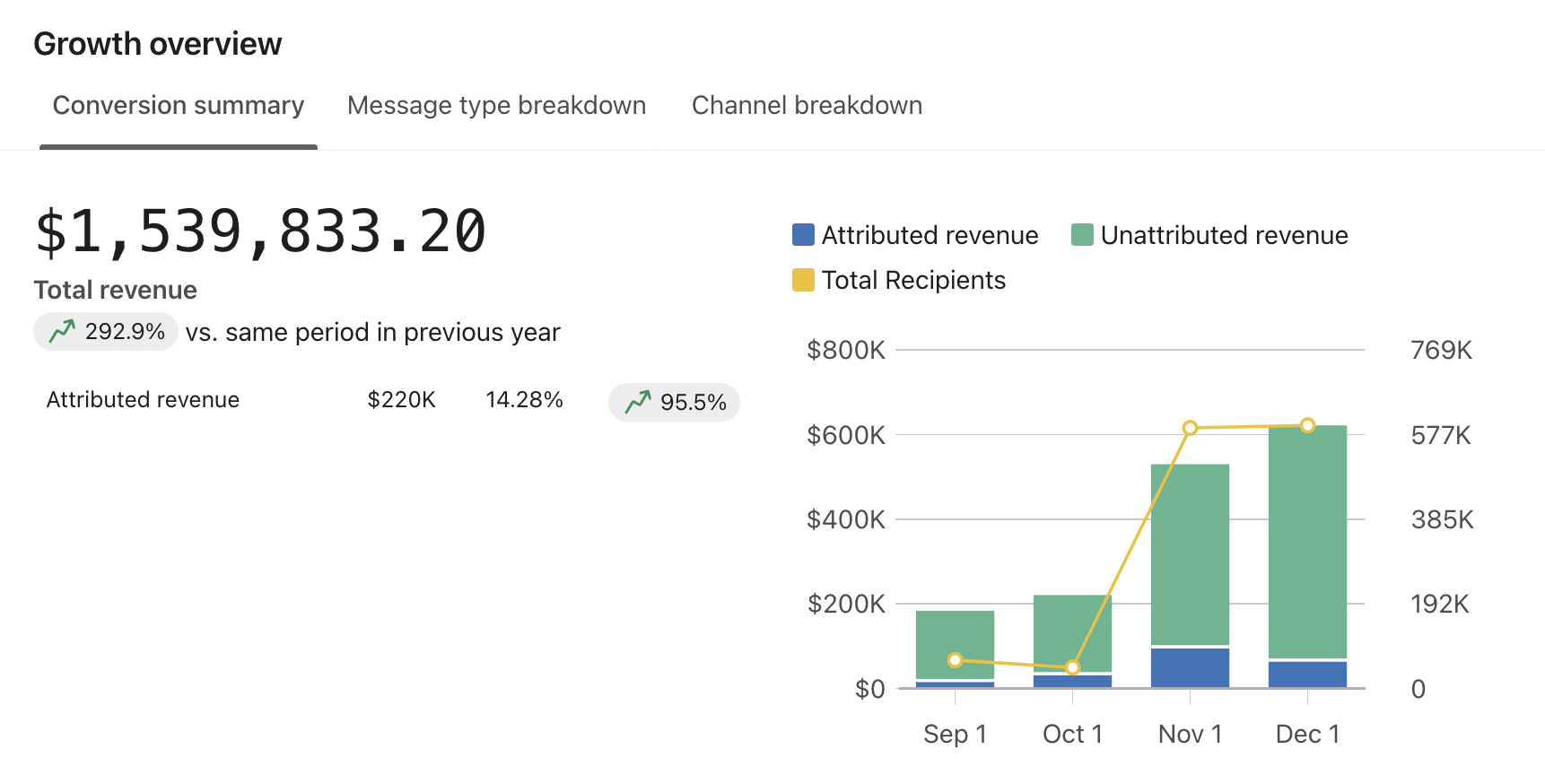
Within the first 90 days of implementing these flows, Peta Jane Beauty saw:
- +27% lift in repeat purchase rate
- 25% increase in topline revenue from email alone
- A stronger sense of customer loyalty, reflected in higher engagement and customer lifetime value
Within one year, Peta Jane Beauty saw:
An overall increase YOY of 95.5% for attributed email revenue highly influenced by these changes we implemented.
CHALLENGE
- Paid acquisition was becoming more expensive.
- A large portion of customers were buying once but not returning.
- The brand needed a retention strategy that could turn first-time buyers into loyal repeat customers.
OUR APPROACH
Accent Studio partnered with Peta Jane Beauty to provide in-depth consultation to design and strategy – optimizing their backend lifecycle flows.
We focused on three key areas:
1) Welcome Flow
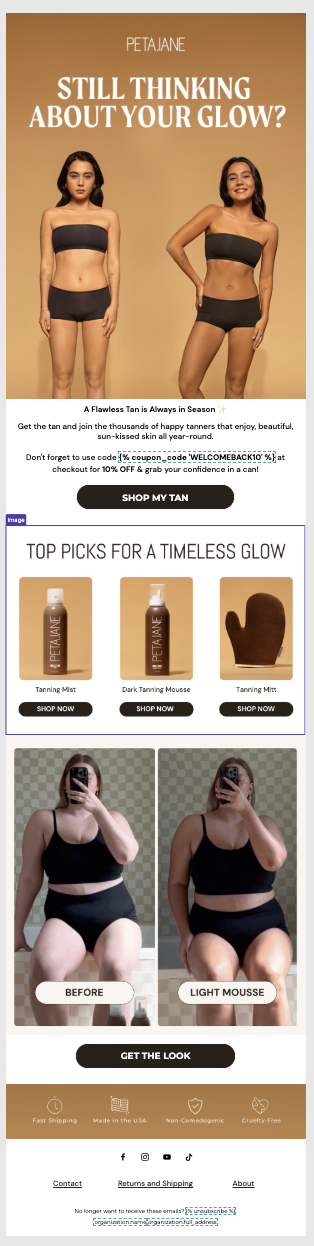
Set expectations, highlight brand values, and drive first purchase confidence.
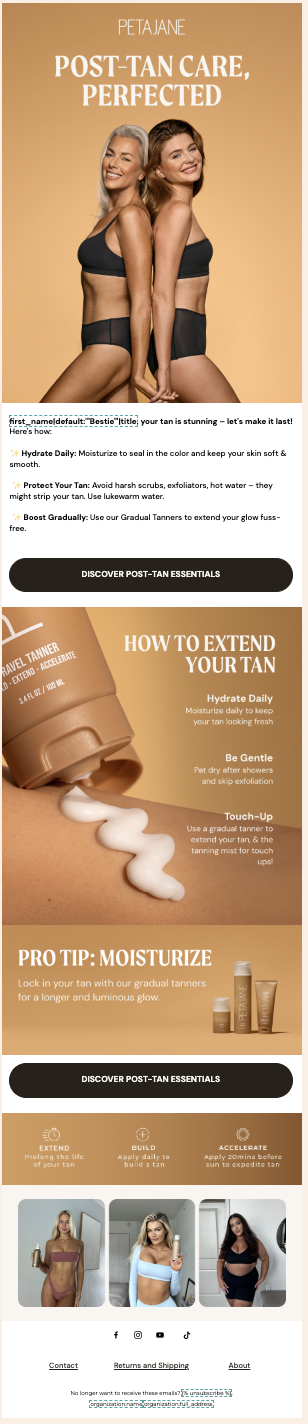
2) Post-Purchase Flow
Delivered usage tips, cross-sells, and reminders to reorder, turning first-time buyers into repeat customers.
3) Re-Engagement / Win-Back Flow
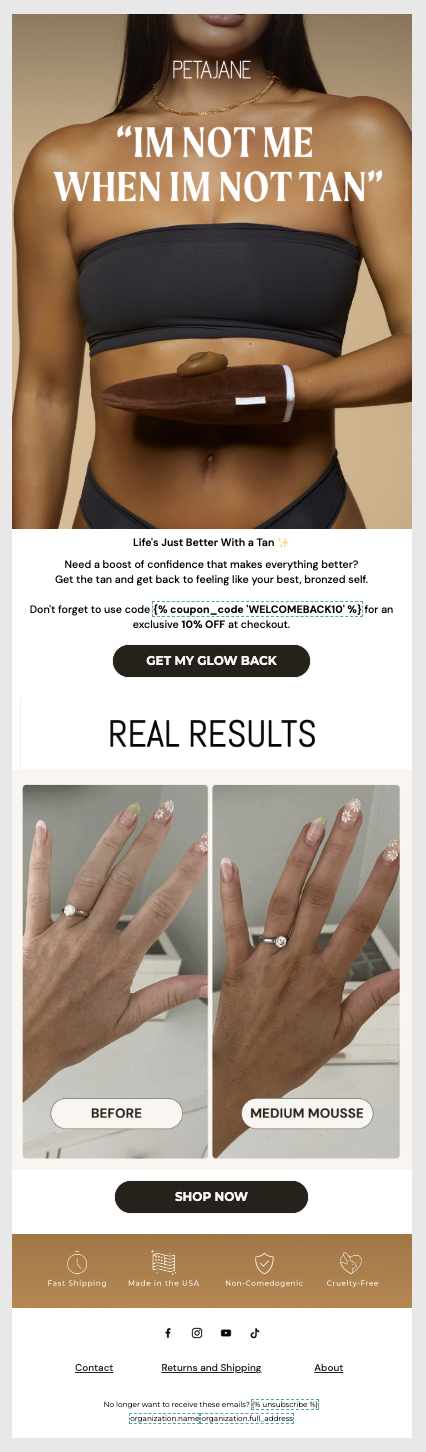
Brought lapsed customers back with a “I’m not me, when I’m not tan” theme showcasing before and after shots and a discount to try again.
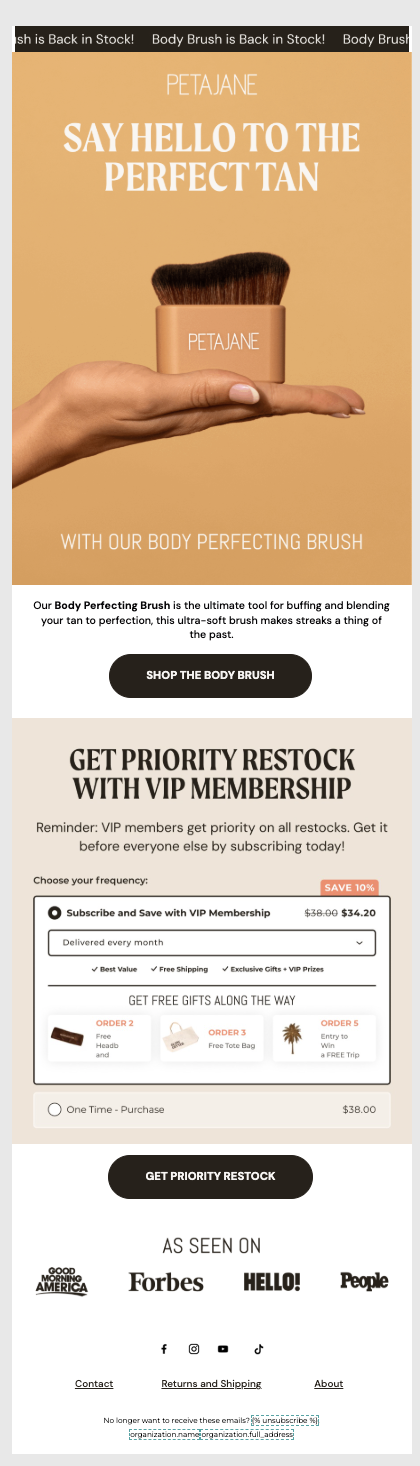
4) VIP Priority Flow
Make customers who spend the most feel extra special with priority restocks, specialized product recommendations, and free gifts.
5) Abandoned Cart Flow
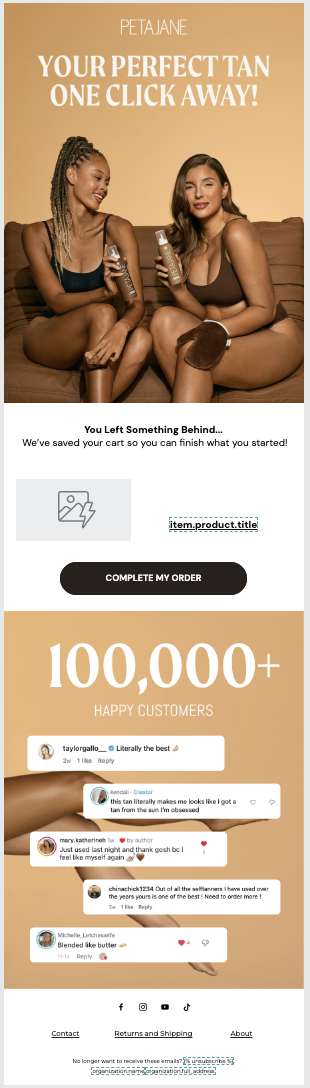
Refreshed the strategy of this flow to include more touch points right when the customer needs them and added more interactive user generated content, reviews and social sharing of other customers results.

KEY TAKEAWAY
For beauty & wellness brands, long-term growth doesn’t come from chasing one-time buyers – it comes from creating seamless customer experiences after the first order.
By dialing in lifecycle flows, Peta Jane Beauty unlocked consistent, predictable revenue growth without increasing ad spend.

Email Marketing: The Evolution, the Myths, the Mastery
Ah… email. Since its humble beginnings in 1971, this digital communication tool has quietly shaped the way we connect, communicate, and conduct business. Fifty-plus years later, it’s still going strong.
Over the decades, the digital space has evolved dramatically, giving rise to groundbreaking innovations:
The rapid evolution of technology is nothing short of astounding:
- The first cell phone was developed in 1973.
- 1980 brought the dawn of online shopping.
- By 1981, the first laptop was a reality.
- Color plasma displays debuted in 1992.
- The iPod hit the market in 2001, followed by YouTube’s launch in 2005, the iPhone’s release in 2007, and the iPad in 2010.
And here we are in 2024, communicating through everything from Sanskrit to Slack, navigating an endless array of devices—phones, laptops, and everything in between. Emails have been a cornerstone in this progression.
From Letters to (e)Mail: A Brief History
Before emails, communication was more tactile and personal:
Writing. Letters.
Yes, people wrote letters, talked more on the phone, and even showed up at each other’s homes. Imagine that!
The world of sales and advertising mirrored this tangible approach with newspaper ads, TV commercials, telemarketing, and door-to-door selling. However, everything shifted in 1978, just seven years after email’s invention. A company sent e-marketing material to over 400 contacts and generated $13 million in sales. This event forever altered the trajectory of communication and marketing.
Over the next two decades, email marketing became indispensable. Computers became household staples, transforming into the new television. Fast forward to today, nearly everyone has an email address—and checks it daily.
In January 2022, 92% of the U.S. population actively used email as a communication tool.
Key Stats on Email Marketing:
- 60% of users prefer brands to contact them via email.
- 59% of consumers say email marketing influences their purchasing decisions.
The takeaway? Email marketing isn’t dead.
Your perception of it—or your strategy—might be.
Email Marketing: A 50-Year-Old Strategy That Works
Despite its age, email marketing remains one of the most effective tools in a marketer’s arsenal. Why? Let’s explore.
The Myths
- “Millennials don’t subscribe to email marketing.”
Wrong. Millennials and Gen X check and use their emails more than any other age group—including Boomers. - “You need an extensive list to see results.”
Not true. Smaller, well-segmented lists often outperform larger ones. Understanding your audience and solving their problems is the key. - “Email marketing is complicated and expensive.”
On the contrary, email marketing platforms like MailChimp or Klaviyo are affordable and user-friendly. Campaigns are straightforward to set up, especially compared to the constant demands of social media content creation.
The Reality
Email marketing delivers a 4,200% ROI—a statistic so powerful that 4 out of 5 marketers would choose it over social media marketing. Here’s why it works:
- Targeted Audience
Unlike social media or PPC, email marketing reaches an audience already interested in your brand. Half the battle is already won. - Cost and Time Efficiency
Email marketing is inexpensive, and setting up campaigns is relatively quick. Unlike the relentless demands of social media, emails can—and should—be simple. - Personal Connection
Emails allow for unmatched personalization. A simple, heartfelt message connects more than a loud, flashy advertisement. Forget blinding “HUGE SAVINGS” banners. Instead, focus on your customer’s needs and stories.
The Future of Email Marketing
Email marketing isn’t going anywhere—it just needs to evolve. In today’s world, overrun by flashy content and superficial ads, success lies in being intentional, personal, and genuine.
If businesses embraced these principles, not only would they see higher profits, but they’d also build lasting relationships with their customers.
So, what do you want for your business? Maybe email marketing is the answer. The only way to know is to do it right.
If your looking for email marketing done right, we’re here to help! Book your Discovery Call today!

КРАКЕН ТЕЛЕГРАМ ТОР ШОП БОТ ЗАКЛАДКИ
Lately, we’ve been getting a lot of questions about Klaviyo’s pricing update. Let’s break it down and see what’s really going on —and how small businesses can SAVE MONEY.
WHAT’S HAPPENING?
Starting February 18th, Klaviyo will enforce pricing based on “Active profiles” for legacy accounts.
Previously, you only paid for emailed contacts, but that loophole is closing. For existing customers, price increases will be capped at 25%—unless you downgrade your plan.
WHO DOES THIS AFFECT?
Small businesses, particularly subscription brands, may feel this the most.
Why? Many subscription brands hold large numbers of “Active profiles” but email less often to avoid annoying customers. Businesses with longer purchase cycles or seasonal demand—who send emails infrequently—may also face higher costs without proportional email activity.
WHY IS KLAVIYO DOING THIS?
Klaviyo is now a public company, meaning their decisions must align with shareholder interests.
Their last price hike saw little churn, signaling that customers value their platform enough to absorb increases. Now, they’re testing the market again. This could also reflect pressure to maximize short-term profits as they expand into new industries and verticals.
HOW CAN YOU LOWER YOUR COSTS?
Here are two key strategies to help manage costs:
1. Clean Your Email List (and Keep it Clean)
Pruning inactive subscribers is critical for reducing costs. Here are some additional tips:
Identify Inactive Profiles: Go beyond engagement metrics and segment profiles with no purchases, site activity, or email clicks in the last 6–12 months.
Re-engage Before Suppressing: Send a targeted “We Miss You!” campaign with an exclusive offer to see if inactive subscribers can be won back.
Focus on Quality Over Quantity: Suppress any contacts who remain unresponsive after re-engagement efforts.
Use Automation: Implement a “Sunset Flow” that automatically suppresses profiles meeting inactivity criteria.
Trim Non-Buyers: If someone has been on your list for 6+ months and never purchased, consider suppressing or removing them.
Review Consent: Check that your contacts have opted in properly to avoid wasting resources on uninterested subscribers.
2. Consider Switching Platforms
Switching email platforms can save money, but it’s not a decision to take lightly. Here’s what to consider:
Feature Parity: Ensure the new platform offers the tools you rely on, like advanced segmentation, automations, and integrations with your eCommerce stack.
Migration Costs: Factor in the time and resources required to move data, recreate automations, and train your team on a new system.
Scalability: Will the new platform grow with your business? A cheaper option might cost more in the long run if it limits your growth.
Hidden Costs: Look beyond headline prices—some platforms charge extra for transactional emails, SMS, or certain integrations.
Customer Support: Switching to a budget platform could mean sacrificing the level of support Klaviyo provides.
THE BIG QUESTION
Most small businesses will probably absorb the price increase—but here’s what you need to ask yourself:
“Am I using Klaviyo to its full potential, or could I save money with a simpler platform while maintaining results?”
Evaluate your options carefully:
Quantify potential savings.
Assess the opportunity costs of switching platforms.
Consider where your time and budget are best spent to drive growth.
Klaviyo’s price hike reflects its position as a leading email platform, but it also reminds us to stay focused on what truly delivers value to our businesses.
What should you do now?
Ultimately, the decision is with you. You know your business best! Take time to evaluate. Look at your current costs, potential savings, and—most importantly—what drives the most value!
If you choose option 1, we can help you clean out your list for a small fixed fee.
If you choose option 2 we’re offering a free migration service for all of Quarter 1 in 2024 – complete with flow, template and segmentation carry over – done in 72 hours or less to Omnisend, our partner of choice!
Book a Discovery Call to get started!